
The question
How can the carrying capacity of a historic street be estimated, and how can image sensors be used to monitor in real time when and why it is exceeded, so that preventive management measures can be triggered?
The method
Experimental case (design science research) on a pedestrian street next to Valencia cathedral: a 2D camera with automatic people counting (convolutional neural networks), readings every 10 seconds between 9 am and 7 pm; usable area calculated with GIS and a 3D model; comfort thresholds based on proxemic distances; analysis of three representative days (23/11/2023, 5/3/2024, 12/5/2024) cross-checked against the events calendar.
What the study finds
- On the city's main religious festival day (12 May 2024) 147,058 people were counted, and the comfort level was exceeded from the moment monitoring began. Across the three days analysed, threshold breaches coincide with local calendar events.
- Citing other studies, the authors report that 2D cameras can reach up to 98% counting reliability and work well in small-scale public spaces; the study does not present its own validation of the counts.
From the study's figures
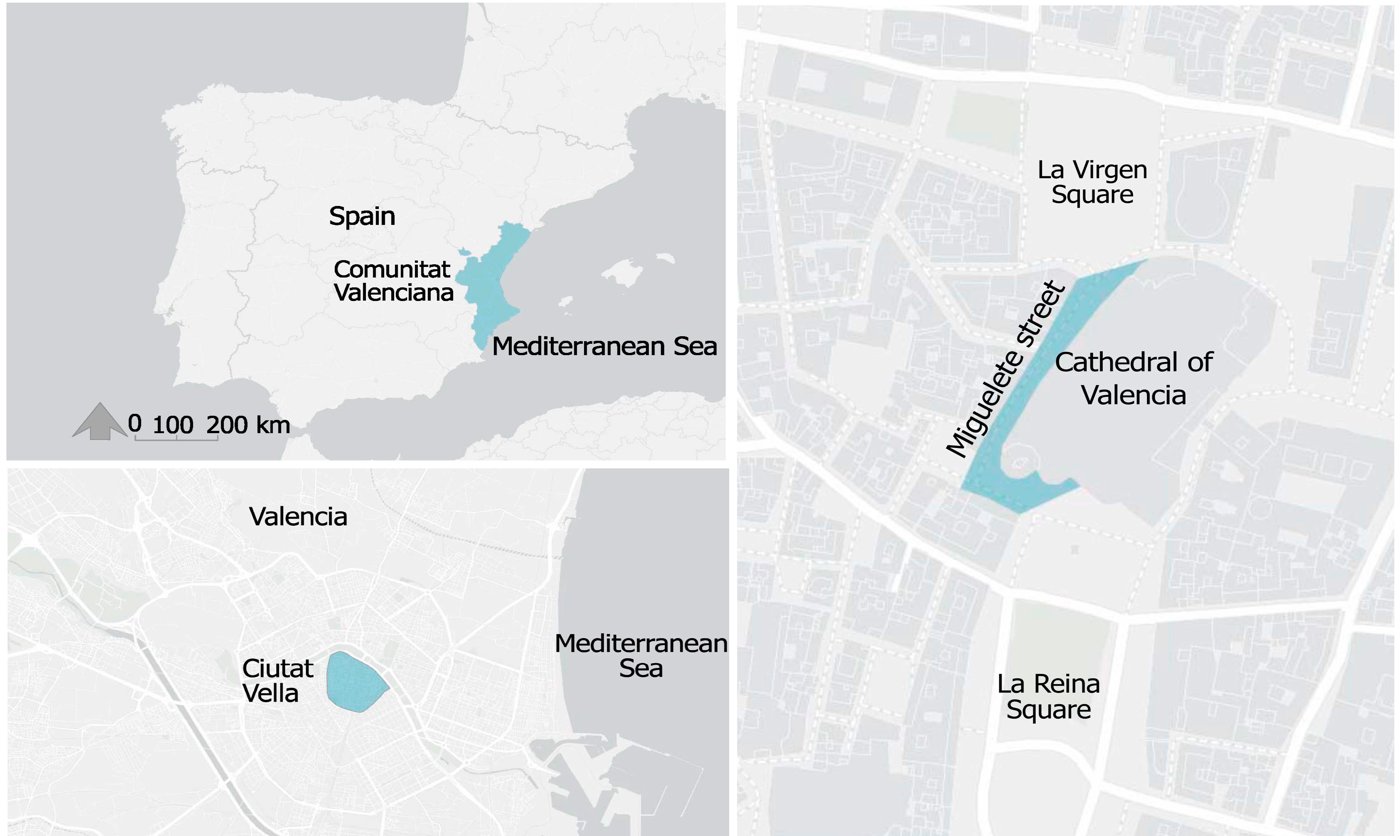
Figure from Viñals, M. J.; Orozco Carpio, P. R.; Teruel, P. et al. (2024), CC BY 4.0 licence.
For historic cities with concentrated inflows, potentially including cruise visitors (whom the study does not address directly), the paper proposes a method to turn a street's carrying capacity into operational thresholds and real-time alerts. In the case analysed, threshold breaches coincide with local calendar events, useful information for scheduling group arrivals.
Limitations
A single street and three illustrative days; generic proxemic thresholds that do not account for differences between visitors; no distinction between residents, tourists or cruise passengers; informal events not tracked and possible data loss.
Viñals, M. J., Orozco Carpio, P. R., Teruel, P., Gandía-Romero, J. M. (2024). Real-Time Monitoring of Visitor Carrying Capacity in Crowded Historic Streets Through Digital Technologies. Urban Science 2024, 8, 190 (MDPI).
Read the original study ↗Summary written by the ODYBOAT Observatory in our own words. Tables and figures belong to the authors.