
The question
How do independent transit cruise passengers visiting Barcelona move on foot, which walking profiles can be distinguished, and how do these profiles relate to visit characteristics and to how the experience is perceived (heat, benches, crowding, satisfaction)?
The method
GPS tracking (one logger per group, one point every 15 s) and a post-visit questionnaire covering 793 independent transit cruise passengers, collected at the port of Barcelona on 39 days between July and October 2022. Walking indicators computed from the tracks, clustering with Gaussian mixture models (5 profiles), binary logistic regressions and Kruskal-Wallis tests on perceptions.
What the study finds
- The analysis distinguishes five walking profiles; the largest group is the 'average walkers' (34.7% of the sample), while those who barely walk make up only 4.5%. 'Extreme walkers' account for 17%.
- Which profile a visitor falls into depends mainly on what they do during the visit (transport used, activities) rather than on personal traits. For instance, taking the hop-on hop-off sightseeing bus is associated with roughly 25 times higher odds of being a 'selective walker'.
- Satisfaction with the visit is high and similar across all profiles (4.4 to 4.6 out of 5), whereas the feeling that some places were too crowded to enjoy differs significantly between profiles (average scores from 3.1 to 3.6).
From the study's figures
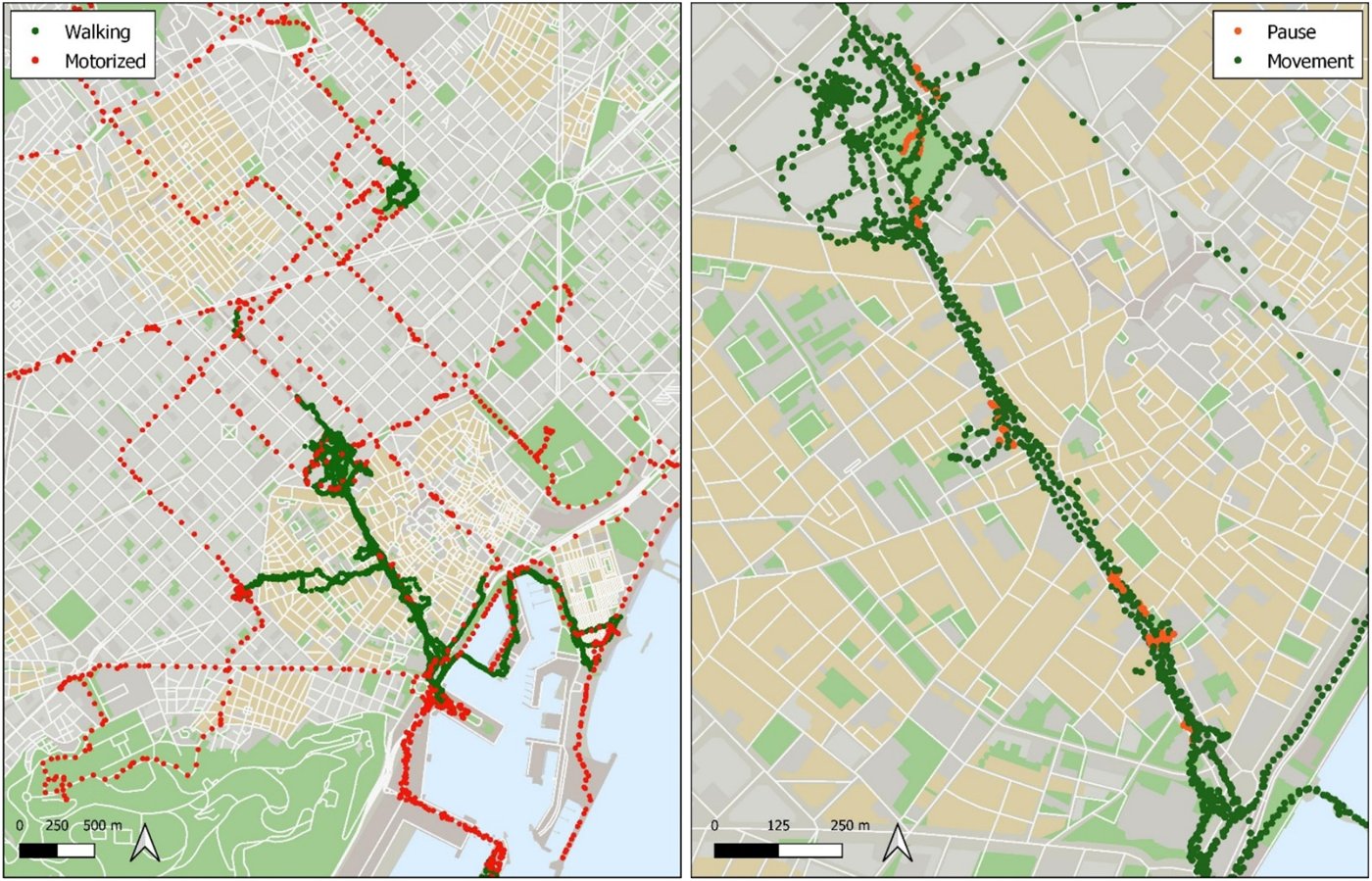
Figure from Delclòs-Alió, X.; Arias-Sans, A.; Tavafi, F. et al. (2025), CC BY 4.0 licence.
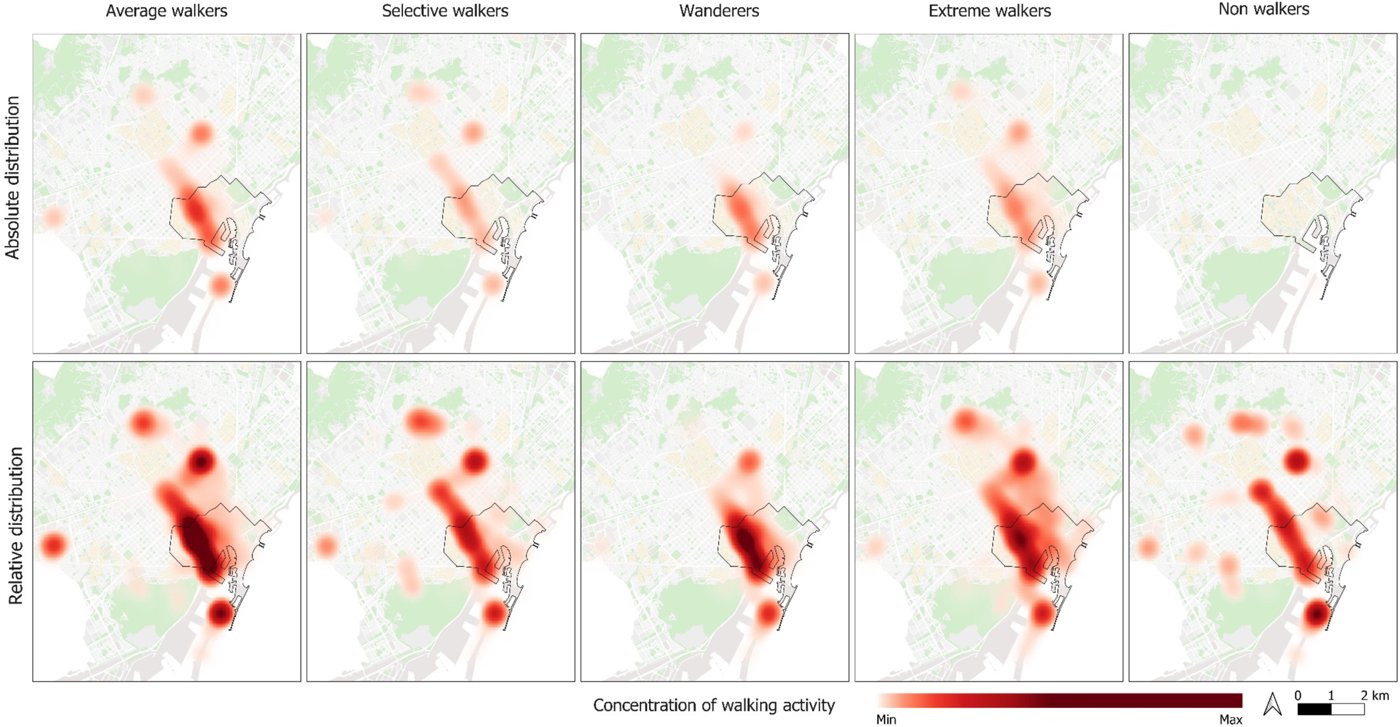
Figure from Delclòs-Alió, X.; Arias-Sans, A.; Tavafi, F. et al. (2025), CC BY 4.0 licence.
For independent cruise visitors the city is explored mostly on foot and within a few hours, with strong concentration along a few central corridors. Decisions on shuttle drop-off points, shade, seating, wayfinding and alternative routes directly affect both visitor experience and pressure on public spaces shared with residents.
Limitations
Only independent transit cruise passengers, a single city and a single post-COVID season (2022, with a lower-than-usual share of US passengers); the speed/distance thresholds used to define walking and the self-reported data may introduce inaccuracies.
Delclòs-Alió, X., Arias-Sans, A., Tavafi, F., Mejía, V., Catalán, M., Gutiérrez, A. (2025). Stepping on the beaten track? Walking behavior and profiles of cruise passengers in Barcelona. Cities, vol. 159, 105760 (Elsevier).
Read the original study ↗Summary written by the ODYBOAT Observatory in our own words. Tables and figures belong to the authors.