
The question
How can port authorities and cruise terminal operators support sustainable shore visits, linking cruise lines' offer with local businesses and reducing congestion?
The method
Comparative qualitative case study of two transit ports (Lisbon and Livorno): in-depth structured interviews with port and tourism managers, observation of infrastructure and secondary data, including an IRPET survey of 2,288 cruise passengers in Livorno (2016) and surveys of about 1,000 passengers a year in Lisbon.
What the study finds
- In the comparison, Lisbon works as a 'destination' port (cruise visitors mainly tour the city) while Livorno is a 'gateway' to inland Tuscan sites: the port's role shapes where visitors end up.
- Lisbon secured longer ship stays from cruise lines; the authors regard extending the call as an effective way to curb congestion from very short visits.
- In Livorno the study finds weak public policy and no integration of tourism into local strategic planning, with little consultation among the port authority, businesses, trade bodies and public institutions.
- As a proposal rather than a tested result, the authors envisage a cruise terminal offering a high-quality taste of regional food, products and culture, benefiting residents and visitors alike and encouraging longer or repeat visits.
From the study's figures
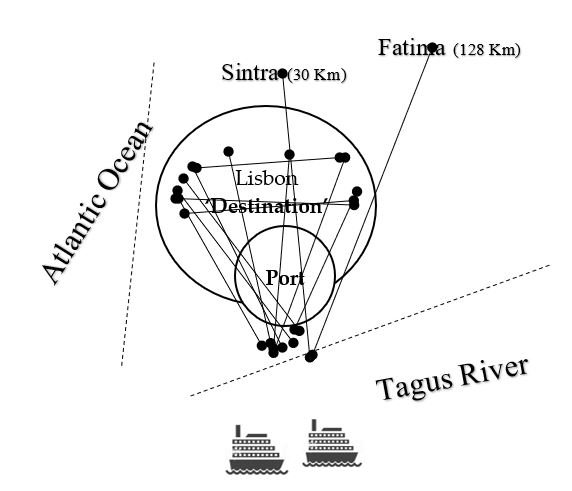
Figure from Santos, M.; Radicchi, E.; Zagnoli, P. (2019), CC BY 4.0 licence.
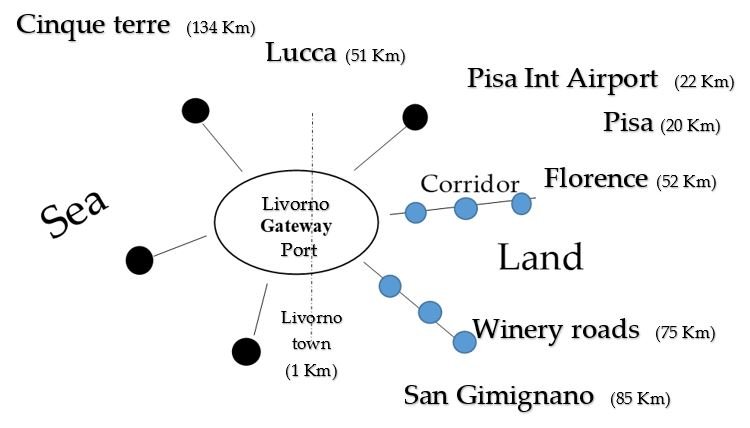
Figure from Santos, M.; Radicchi, E.; Zagnoli, P. (2019), CC BY 4.0 licence.
It shows that the port is not only infrastructure but an actor able to influence call duration, local offer and visitor distribution. Comparing a destination port with a gateway port clarifies why flow-management solutions must differ from one call to another.
Limitations
Only two cases and qualitative interviews; the passenger surveys used were not designed for this research, and segmentation and spending data are missing, as the authors acknowledge.
Santos, M., Radicchi, E., Zagnoli, P. (2019). Port's Role as a Determinant of Cruise Destination Socio-Economic Sustainability. Sustainability (MDPI), 11, 4542.
Read the original study ↗Summary written by the ODYBOAT Observatory in our own words. Tables and figures belong to the authors.